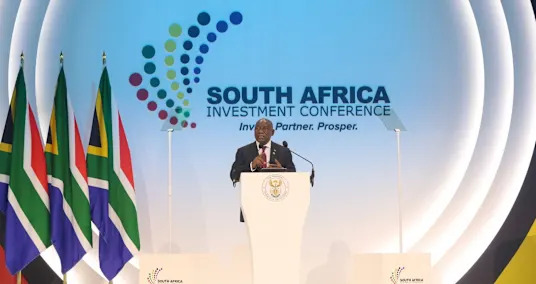
South African President Cyril Ramaphosa launched a nearly $200 billion investment drive aimed at accelerating economic recovery and industrialization in the face of growing worry over the impact of the Iran war on the continent’s biggest economy.
For more than a decade, South Africa’s economy has barely grown, leaving it with crumbling infrastructure and the need to create jobs in a country where one in three people are unemployed. Ramaphosa’s pitch to investors in Johannesburg this week was that South Africa has fixed the worst bottlenecks: He said the country is opening key sectors to private capital and is ready for large scale investments.
Ramaphosa said the effort will run through 2030 with delegates at the South African Investment Conference pledging $53 billion across 31 projects spanning energy, logistics, manufacturing, and digital infrastructure. They include Coca-Cola’s $1 billion expansion plan, and a $3.6 billion commitment from Sasol — the world’s biggest maker of fuel from coal — to upgrade operations.
latest_posts
- 1
 FDA adds strongest warning to Sarepta gene therapy linked to 2 patient deaths
 - 2Who was Haytham Ali Tabatabai, Hezbollah's military leader killed by Israel?
- 3Cyber Monday Paramount+ deal: Save 50% and stream these buzzy Taylor Sheridan shows
- 4Unfathomable and Entertaining Legal disputes That Surprise everyone
- 5Reporter's Notebook: The Post embeds with foreign armies visiting the IDF


- Embrace the Outside: Exercises and Entertainment
- Everyone knows F1 is for the girls. I wandered into the Las Vegas desert to find out why.
- High Court weighs Assenheim appeal over release of Feldstein interview raw footage
- Wellness Bits of knowledge Readily available: A Survey of \Following Wellbeing and Progress\ Wellness Wearables
- Huge solar flare no threat to Artemis 2 astronaut launch to the moon, NASA says
- Change Your Skincare: 10 Inventive Magnificence Gadgets
- Eco-Accommodating Kitchen Machines: 4 Picks for a Manageable Home
- Flu cases spiking this holiday season, CDC data shows
- Ifo: Job cuts in Germany slowing but not enough for a turnaround